I am closer to the end of my life than the beginning. I am a single parent sharing the care of two teenagers 50/50 here in Aotearoa New Zealand, and I care deeply about their future—and about the generations of human and more-than-human life that will follow them.
I have been through difficult periods of trying to get my head and heart around what is happening in the world. The most reliable antidote to helplessness that I have found is to try to understand our predicament at a deeper level.
I have been searching for language through which I can share that understanding without overwhelming people who are only beginning to dip their toes into these questions, or frightening those who are just becoming aware of the interrelated crises we face.
It is not about any single crisis. It is about the growing distance between what is happening around and between us, and the seriousness with which we appear willing to respond.
I am not asking us to pay closer attention because I possess a complete explanation of what is happening. Nor do I have a ready-made programme for what should replace the systems we currently inhabit. There is no single solution to a predicament this complex. What we may be able to find is a series of choices, experiments and actions that begin to change the trajectory.
I am asking because I no longer believe that looking away is a neutral act.
Extreme wealth continues to concentrate in fewer hands. We have become accustomed to levels of personal wealth that no one could reasonably spend, existing alongside forms of insecurity that no one should reasonably endure.
Housing, food, energy, healthcare and other foundations of a dignified life have become increasingly difficult for many people to secure. At the same time, those who already possess significant assets are often best positioned to accumulate even more.
There are people inside and outside politics working to challenge this. There are proposals for fairer taxation, stronger public services and greater social protection. But I see little political appetite for confronting the underlying structures through which wealth and power continue to concentrate.
We debate the symptoms while leaving the direction of travel largely unchanged.
The same absence of proportionate response can be seen in our relationship with the climate.
The climatic conditions upon which human societies and present-day ecosystems depend are changing. This is not simply another environmental issue competing for attention alongside the economy, healthcare or housing. Climate is one of the underlying conditions upon which food, water, habitation, health and social stability depend. It is not merely a backdrop to life; it is one of the conditions that makes life as we know it possible.
We acknowledge climate change through speeches, targets and plans. Yet when meaningful action threatens established patterns of economic growth, consumption, ownership or political advantage, urgency repeatedly gives way to delay.
The issue is not that nothing is being done. The issue is that what is being done remains profoundly disproportionate to what we know.
Meanwhile, younger generations are being asked to inherit the consequences.
They face ecological instability, insecure and unaffordable housing, degraded public infrastructure and economic systems increasingly unable to provide confidence in the future. At the same time, a smaller working-age population will be expected to sustain the institutions of society and provide care for a growing older population.
This should not become a story of younger people against older people. Ageing is not the problem, and caring for people throughout their lives should be one of the clearest expressions of a humane society.
The problem is our collective failure to prepare.
We have known that populations were ageing. We have known that housing wealth was becoming increasingly concentrated. We have known that ecological disruption would place greater pressure upon food, health, infrastructure and public finances. Yet we have continued to organise society in ways that transfer growing burdens into the future. We have, in effect, kept kicking the can down the road.
Every generation deserves to be cared for. The question is whether we have built systems capable of providing that care without exhausting those who follow us.
It is tempting to describe these conditions as things being done to us by forces beyond our control. We speak about “the economy” as though it were a machine operating somewhere outside society. We speak about “politics” as though it were merely a spectacle performed by other people.
But our political and economic systems are not separate from us.
They are human arrangements. They are created and reproduced through laws, institutions, investments, workplaces, property relations, patterns of production and consumption and the stories we accept about what is realistic or inevitable.
Recognising this does not mean pretending that everyone holds equal power or bears equal responsibility. Some people and institutions possess vastly greater influence, accumulate far greater benefits and have far more freedom to choose differently. Responsibility must always be understood in relation to power.
But unequal responsibility does not make the rest of us separate from the systems we inhabit. Individually, most of us possess limited power to alter these arrangements. Collectively, however, we possess far more power than we often recognise.
We participate in them. We depend upon them. We reproduce parts of them through ordinary life, often because meaningful alternatives have been made difficult or unavailable. We inherit assumptions about success, security, ownership and progress, and can find ourselves defending arrangements whose consequences we would never have consciously chosen.
This recognition is uncomfortable, but it also contains possibility.
If these systems were produced through human choices, they can be changed through human choices. Not easily, quickly or individually—but collectively, deliberately and over time.
That possibility carries responsibility.
Human beings do not live above or outside the living world. Our food comes from soil, water, sunlight and the labour of innumerable living beings. Our economies remain dependent upon materials and energy drawn from the Earth. Our health is inseparable from the health of the wider systems within which we live.
The more-than-human world is not scenery surrounding the human project. Nor is it merely a stock of resources awaiting conversion into economic value.
We inhabit an ecosphere that was not created for us alone, that we do not control and whose life-supporting systems we cannot replace.
Our responsibility is not to design the whole world as though it belonged to us. It is to shape human arrangements capable of belonging within a living world—to create ways of provisioning, governing and caring that support human dignity while respecting the boundaries required by other forms of life.
This is where attention becomes important.
Paying attention can sound like a modest response to problems of such magnitude. But what we attend to determines what we are capable of seeing, understanding and choosing.
When our attention is fragmented, the relationships between problems remain hidden. Housing is discussed separately from wealth. Food is separated from energy and land. Health is separated from inequality and ecological conditions. Climate is isolated from the economic system driving material consumption. Politics is separated from the everyday institutions through which power is exercised.
We encounter each crisis as a separate emergency and rarely remain with any of them long enough to ask what connects them.
Paying closer attention means slowing down enough to notice those relationships.
It means asking who benefits, who pays and whose lives are treated as expendable. It means examining the assumptions beneath policies rather than only debating their immediate effects. It means listening across difference, staying with difficult questions and allowing what we discover to disturb our inherited understanding of what is normal.
It does not require us to begin with the same answers.
It requires us to take our shared reality seriously enough to examine it together.
Individual awareness is not sufficient because the conditions we face are not individual problems. They are produced through collective systems and will require collective choices.
What we need, therefore, is not only personal attention but collective attention: the civic capacity to notice together, to connect what has been separated, to ask better questions and to deliberate about the conditions under which we want to live.
This is why I feel compelled to issue the invitation.
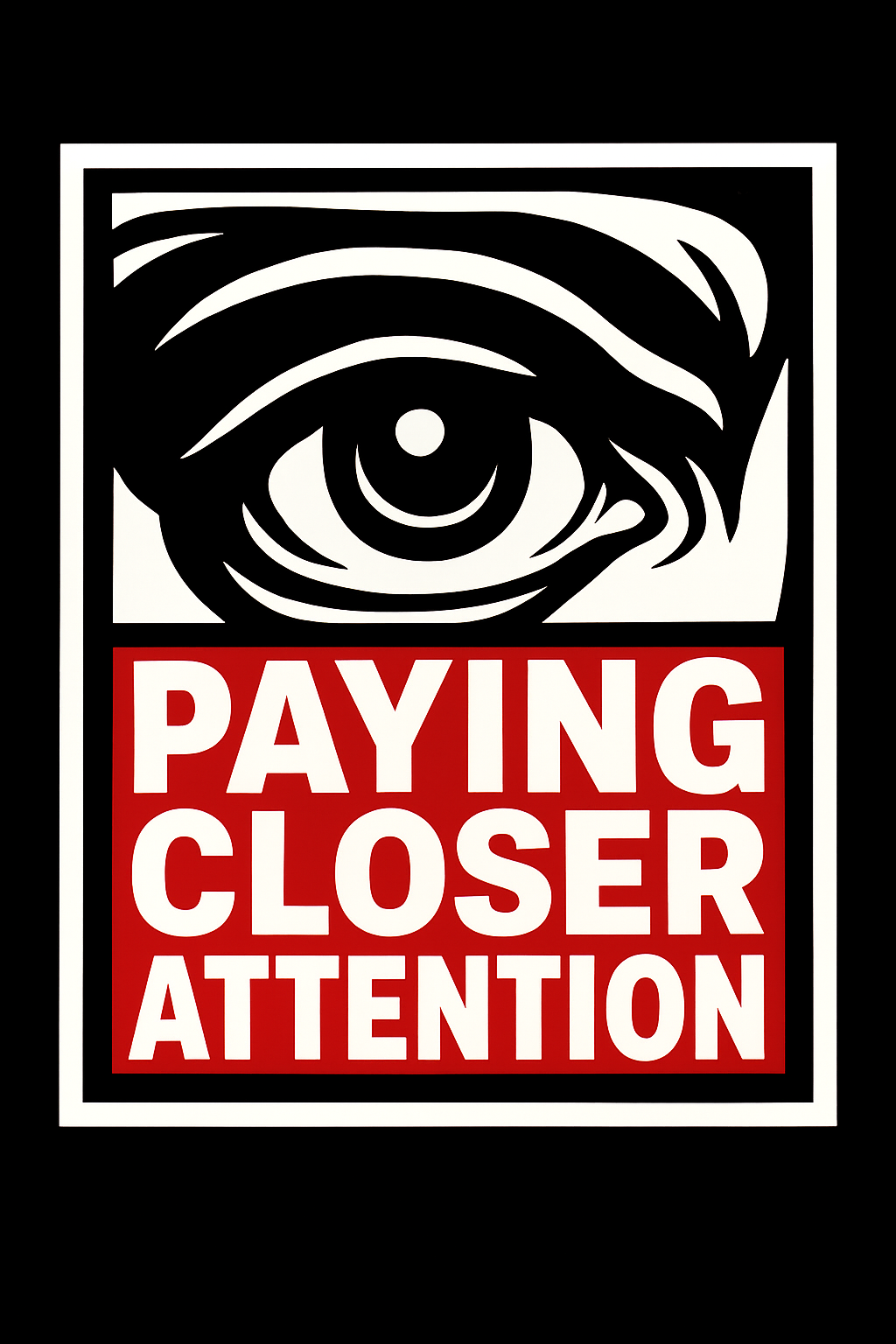
Paying Closer Attention is not an attempt to build an audience around a personality, provide another stream of commentary or tell people what they should think. It is an attempt to create space for deeper public inquiry—for conversations that do not rush towards easy certainty and questions that are not abandoned simply because their implications are uncomfortable.
I expect my own thinking to be challenged and changed through this process.
We will not always agree about what we see, what it means or what should follow. But we can become clearer about the choices being made in our name, the systems we collectively sustain and the futures those systems are producing.
Paying closer attention will not, by itself, resolve inequality, stabilise the climate, rebuild public capacity or create justice between generations and species.
But without sustained attention, we cannot develop public clarity.
Without public clarity, we cannot make well-informed collective choices.
And without collective choice, we will continue to inherit a future shaped by decisions we were discouraged from recognising as decisions at all.
Paying closer attention is the invitation. Collective attention is the practice. Public clarity is a possible outcome. Responsible participation is what follows.